


Claw Machine Distributor: How to Find the Right Manufacturing Partner
A claw machine distributor needs more than a supplier offering competitive equipment prices. The right manufacturing partner should provide suitable machine models, consistent product specifications, clear commercial terms, dependable production planning, and practical after-sales support. Before committing to a bulk order, distributors should compare manufacturers based on product quality, customization options, MOQ, shipping arrangements, spare parts, and long-term cooperation potential.
For importers and arcade equipment wholesalers, choosing the right factory can help build a more competitive product catalog and improve the experience of the businesses they serve.
1. What Does a Claw Machine Distributor Do?
A claw machine distributor purchases commercial claw machines from manufacturers or suppliers and resells them to customers within a defined market. Depending on the business model, customers may include independent arcade operators, family entertainment centers (FECs), shopping malls, cinemas, amusement venues, and other equipment dealers.
Typical distributor responsibilities include:
Selecting products that suit local market demand.
Purchasing equipment and managing inventory.
Marketing products to commercial buyers.
Providing quotations and coordinating delivery.
Helping customers select suitable machine configurations.
Arranging spare parts and technical support.
Managing repeat orders and customer relationships.
Some distributors operate mainly as importers and wholesalers. Others provide installation, venue planning, equipment maintenance, or complete arcade solutions.
Before approaching manufacturers, decide which services your business intends to offer. Your operating model will influence the types of products, documentation, and supplier support you need.
2. Identify Your Target Market Before Choosing a Supplier
A distributor's product range should reflect the needs of its customers rather than simply the number of models available from a factory.
Different Customers Need Different Machines
Target customer | Product considerations |
|---|---|
Independent arcade operators | Practical machine sizes, maintenance access, and suitable prize configurations |
Family entertainment centers | A varied machine lineup, visual appeal, and consistent product specifications |
Shopping malls | Available floor space, appearance, operating requirements, and venue rules |
Cinema operators | Footprint, customer flow, and compatibility with the entertainment environment |
Vending and amusement equipment dealers | Product variety, purchasing terms, documentation, and repeat-order support |
Multi-location operators | Consistent configurations, replacement parts, and repeat-order planning |
Event companies | Transport requirements, setup time, and suitability for temporary installations |
Your target market also affects electrical requirements, payment methods, language, safety documentation, and shipping costs.
For example, a distributor serving several countries may need to confirm different plug types, payment systems, or compliance requirements for each destination.
Practical tip: Start by identifying the three to five machine categories most relevant to your customers. Expand the catalog after you understand demand, stock turnover, and support requirements.
3. How to Find a Reliable Claw Machine Manufacturer
Distributors can discover suppliers through manufacturer websites, industry directories, trade events, professional networks, online B2B platforms, and referrals from existing industry contacts.
Finding a supplier is only the first step. You must then verify whether the company can deliver the product specifications and commercial arrangements your business requires.
Check These Five Areas
1. Manufacturing capability
Review the supplier's product range and manufacturing information. Ask whether the company produces the machines directly, which processes it handles in-house, and which components or services are outsourced.
2. Product suitability
Request specifications for the models that match your market. Compare dimensions, machine functions, payment options, prize compatibility, electrical requirements, and available customization.
3. Quality control
Ask how the manufacturer checks cabinet appearance, assembly, controls, claw movement, payment functions, and other agreed requirements before shipment.
4. Export experience
Confirm whether the supplier can prepare suitable export packaging, shipping documentation, and product information for your destination.
5. After-sales support
Ask how to order spare parts, report faults, obtain troubleshooting assistance, and process warranty claims.
A supplier's website and product catalog can help you prepare questions, but they do not independently prove manufacturing capacity or product quality. Request relevant evidence before placing a substantial order.
4. Factory Direct vs. Trading Company: What Should Distributors Choose?
Both manufacturers and trading companies can be useful purchasing partners. The better option depends on your requirements, order size, product range, and need for customization.
Comparison | Direct manufacturer | Trading company |
|---|---|---|
Product sourcing | Produces the equipment or manages production directly | Sources products from manufacturers |
Customization communication | May offer more direct access to production or engineering teams | May coordinate customization through its suppliers |
Product range | Depends on the manufacturer's own range and partnerships | May combine equipment from several factories |
Commercial pricing | Depends on specifications, volume, and commercial terms | Depends on sourcing arrangements, services, and markup |
Technical support | Depends on the manufacturer's support capabilities | Depends on the trading company's arrangements with suppliers |
Supplier management | Buyer may need to coordinate with several factories | One intermediary may simplify multi-supplier purchasing |
Do not assume that a direct factory will always be cheaper or that a trading company will always provide better service. Compare the total offer, including customization, inspection, packaging, logistics, and after-sales responsibilities.
Questions to Ask a Potential Factory
Do you manufacture this model directly?
Which production processes are performed in your facility?
Can you provide a product specification sheet and current product photos?
Which customizations are supported?
Can I order a sample or a small initial batch?
How are defects handled before and after shipment?
Can you supply replacement parts for the selected models?
What documentation can you provide for my destination market?
Clear answers help you assess whether the supplier is suitable for your distribution business.
5. Build a Competitive Claw Machine Product Catalog
A distributor does not necessarily need every machine type available. A well-planned catalog should make it easy for customers to choose products according to their space, budget, audience, and operating requirements.
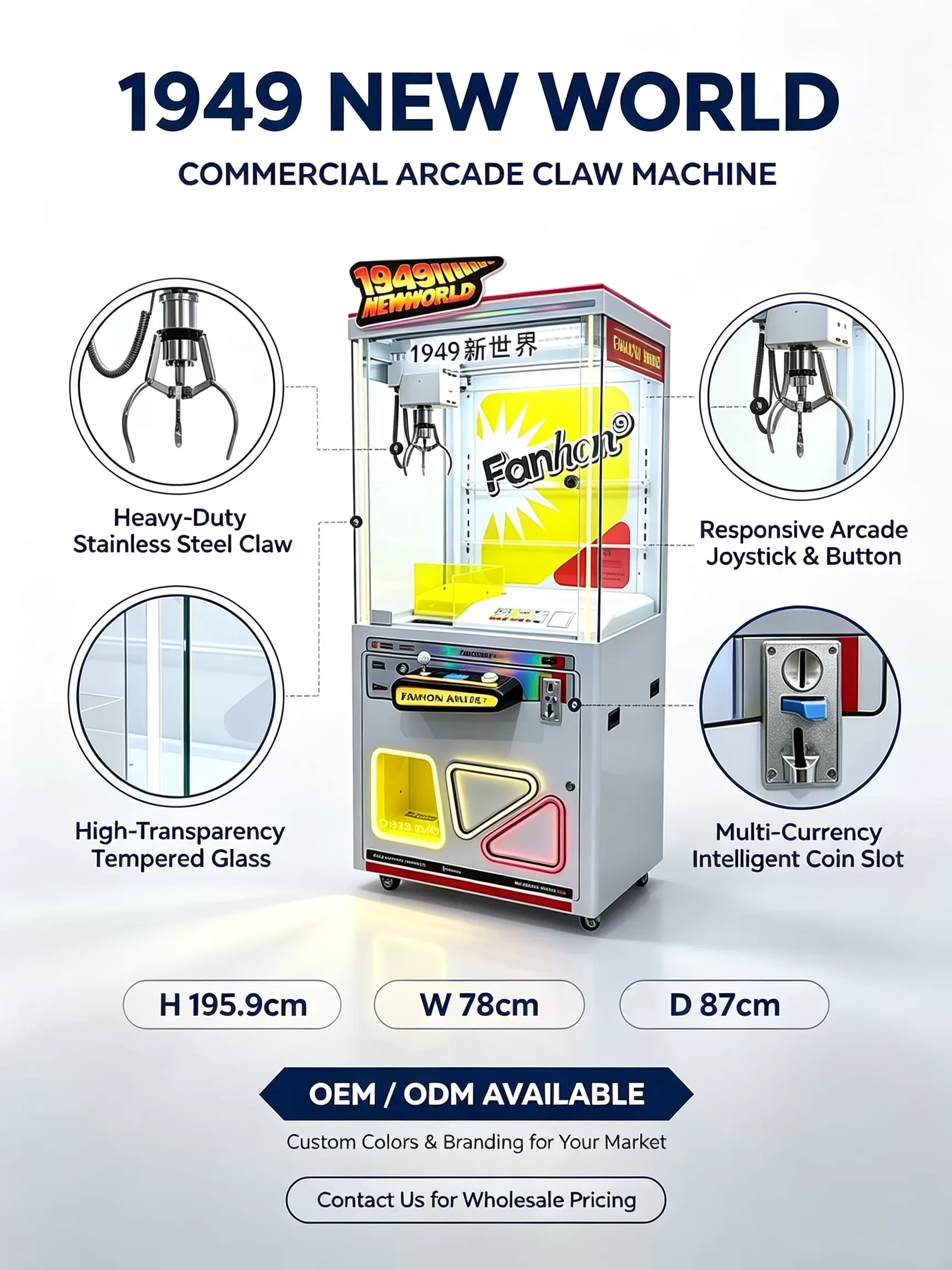
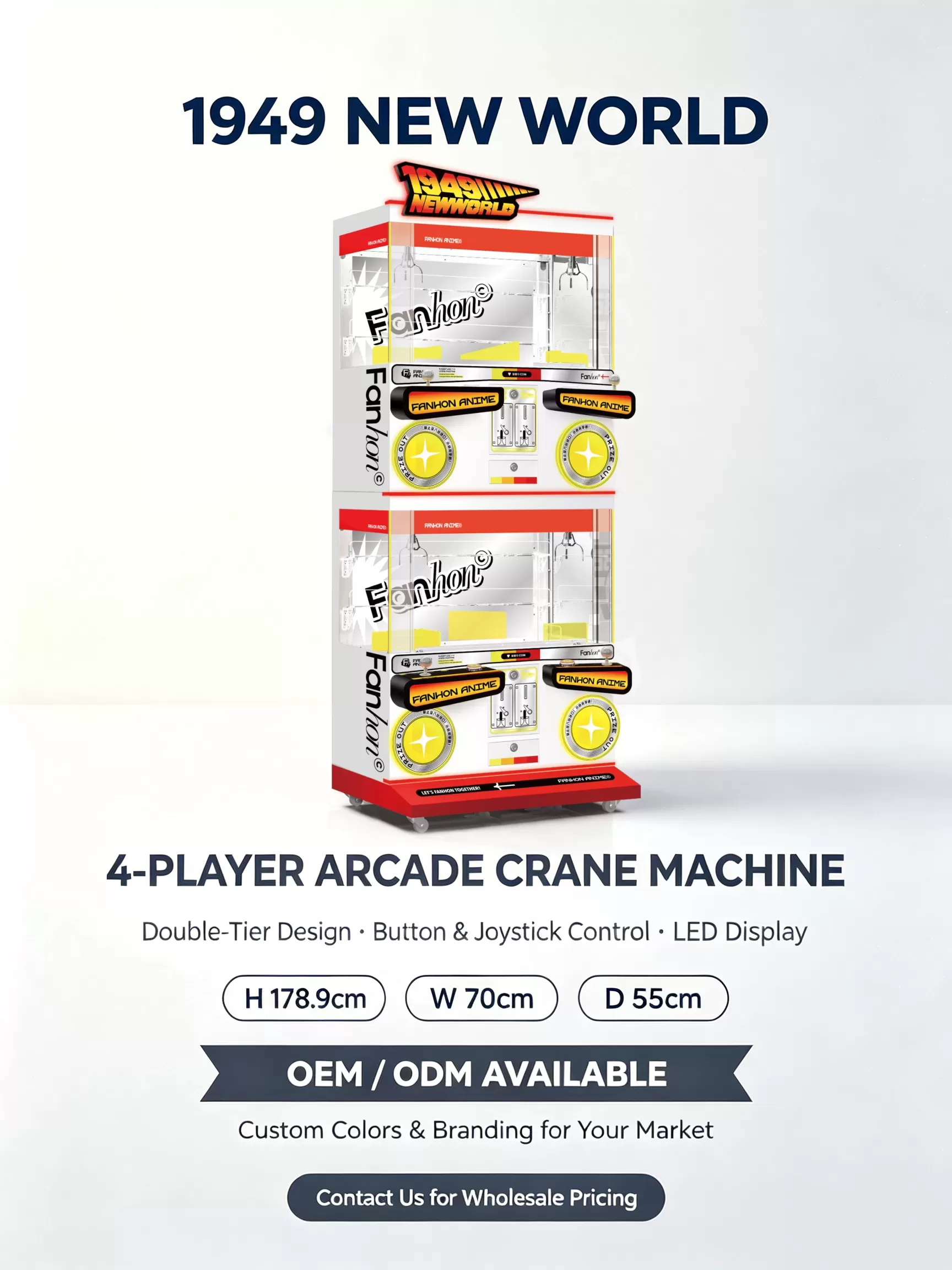
Consider organizing your catalog into the following categories:
Product category | Potential role in your catalog |
|---|---|
Mini claw machines | Smaller installations and locations with limited floor space |
Standard commercial claw machines | General-purpose arcade and entertainment venue applications |
Large prize crane machines | Venues seeking larger cabinets or a more prominent installation |
Shared play experiences and group entertainment | |
Custom branded machines | Customers seeking a specific visual identity |
Other arcade equipment | Cross-selling opportunities for buyers developing a broader equipment lineup |
The most suitable assortment depends on customer demand and the models available from your manufacturing partner.
Create Standard Product Sheets
For every machine you distribute, prepare a consistent product sheet containing:
Product name and model number.
Machine dimensions and weight.
Clear product photos.
Electrical specifications.
Supported payment methods.
Prize compatibility guidance.
Customization options.
Warranty terms.
Available spare parts.
Estimated production and delivery timelines.
Accurate product information helps sales teams prepare quotations faster and reduces confusion between similar models.
If you serve multiple countries, maintain separate notes for market-specific configurations instead of assuming every version has identical hardware or payment support.
6. Understand MOQ, Wholesale Pricing, and Bulk Orders
Manufacturers may offer different pricing and MOQ arrangements depending on the model, order quantity, and customization requirements.
What Affects Wholesale Pricing?
Factor | Why it matters |
|---|---|
Machine model | Cabinet size, components, displays, and construction affect the base price |
Order quantity | Larger orders may change production economics and purchasing terms |
Custom branding | Artwork, printing, finishes, and design changes may add costs |
Payment configuration | Additional hardware or integration may affect pricing |
Spare parts | Initial spare-part packages may be quoted separately |
Packaging | Special packaging requirements may change costs |
Delivery terms | Freight, insurance, customs, and local delivery can materially affect total cost |
Ask suppliers to quote the same models, quantities, customization options, and delivery terms so that you can compare offers fairly.
How to Plan Your First Bulk Order
For a new product line, consider a staged purchasing approach:
Validate demand. Speak with existing customers and identify the machine types they are most likely to purchase.
Evaluate samples. If practical, order a sample or small batch to review product quality and operating requirements.
Select core models. Prioritize products with a clear target audience and suitable technical specifications.
Confirm the economics. Calculate equipment costs, freight, import expenses, storage, marketing, and after-sales reserves.
Agree on specifications. Record the approved configurations and acceptance criteria.
Plan replenishment. Estimate lead times and reorder points based on actual sales and inventory.
Avoid purchasing a large quantity solely to obtain a lower unit price. Unsold stock, storage costs, and slow-moving models can outweigh the initial price advantage.
7. Negotiate Clear Commercial Terms
A supplier relationship should be based on a written quotation and purchase agreement that clearly define the responsibilities of each party.
Before confirming an order, review the following:
Model numbers and quantities.
Unit price and total order value.
Customization costs and approved artwork.
MOQ and any mixed-model conditions.
Payment milestones.
Production lead time.
Inspection and acceptance criteria.
Packaging requirements.
Shipping method and Incoterms.
Responsibility for freight, insurance, duties, and taxes.
Warranty coverage and exclusions.
Spare-part prices and availability.
Procedure for handling defects or shortages.
Confirm the Production Schedule
Production time is only one part of the delivery schedule. A distributor should account for design approval, component preparation, manufacturing, inspection, packaging, shipping, customs clearance, and final delivery.
Ask the manufacturer to distinguish the estimated production period from the overall delivery estimate.
For customized machines, confirm when the production clock begins and whether late changes to artwork or specifications affect the schedule.
8. Plan Spare Parts and After-Sales Support
After-sales support is especially important for distributors because your reputation depends on how effectively you help customers resolve problems.
Before selecting a supplier, ask which spare parts are available, how they are identified, and how customers can order replacements.
Develop a Spare-Parts Plan
Potential spare-part categories include:
Claw mechanisms and related components.
Buttons, joysticks, and control components.
Sensors and switches.
Power supplies and electrical components.
Lighting components.
Locks and access hardware.
Payment-system components, where supported.
The parts required will vary by model. Ask the manufacturer for a model-specific parts list rather than assuming components are interchangeable across machines.
Set a Customer Support Process
A practical distributor support process should define:
How customers report a problem.
What photos, videos, or diagnostic information they should provide.
How the machine model and component are identified.
How warranty eligibility is assessed.
How replacement parts are quoted and shipped.
When technical support is escalated to the manufacturer.
Keep records of the model, serial number where applicable, installation date, reported fault, and resolution. This information can help you identify recurring issues and plan future spare-part purchases.
9. Build a Long-Term Relationship with Your Manufacturer
The best manufacturing relationship is not necessarily the one that offers the lowest price on a single order. Distributors should assess whether a supplier can support their business as the catalog, order volume, and customer base develop.
Review Supplier Performance Regularly
Track measurable indicators such as:
Performance indicator | What to monitor |
|---|---|
Delivery reliability | Whether shipments meet the agreed schedule |
Product quality | Defects identified during inspection or after delivery |
Specification accuracy | Whether delivered machines match the approved order |
Communication | Response quality and handling of technical questions |
Spare-part support | Availability and fulfillment of required components |
Commercial transparency | Accuracy of quotations and communication about additional costs |
Repeat-order consistency | Whether approved configurations are maintained across batches |
Discuss recurring problems with the manufacturer and document agreed corrective actions.
Maintain Approved Product Specifications
For repeat orders, keep the approved artwork, model configuration, payment requirements, inspection checklist, and parts list.
If the manufacturer proposes a component substitution or design change, request written confirmation and assess whether it affects performance, compliance, or compatibility with machines already sold to your customers.
This is particularly important for distributors maintaining product catalogs across several countries.
10. Why Consider Fanhong as a Manufacturing Partner?
Fanhong, operated by Guangzhou Fanhong Animation Technology Co., Ltd., manufactures commercial claw machines and other arcade entertainment equipment in Panyu, Guangzhou, China.
The company serves B2B buyers seeking machines for arcade venues, family entertainment centers, shopping malls, cinemas, and distribution businesses.
Depending on the selected model and project requirements, potential customization may include cabinet colors, logos, decals, lighting, payment configurations, and supported gameplay settings.
Distributors evaluating Fanhong can discuss:
Product selection for their target market.
Available machine models and configurations.
OEM and ODM requirements.
Custom branding and technical feasibility.
Bulk order planning and production scheduling.
Export packaging and shipping arrangements.
Warranty terms, spare parts, and technical support.
Fanhong's typical production estimate for confirmed orders is approximately 25–30 days after payment, subject to the model, order quantity, customization requirements, and production schedule. Confirm the actual timeline and commercial terms for your order.
To explore the product range, visit the Fanhong factory page or contact the team on WhatsApp at +86 18922467886.
11. Frequently Asked Questions About Claw Machine Distributors
1. How do I become a claw machine distributor?
Start by researching your target market, identifying potential commercial customers, and choosing a product range. Then compare manufacturers based on product quality, pricing, MOQ, customization, shipping, and after-sales support. Build a business plan that includes inventory, import expenses, marketing, and customer service.
2. Should I buy claw machines directly from a factory?
Buying directly from a factory may provide more direct communication about manufacturing and customization. However, the best option depends on the supplier's capabilities, product range, service, and total commercial offer. Compare the full package rather than unit price alone.
3. What is the usual MOQ for wholesale claw machines?
MOQ varies by manufacturer, model, and customization requirements. Standard machines, branded products, and extensively customized designs may have different quantity conditions. Request a quotation that specifies the MOQ for each model and customization.
4. Can I sell claw machines under my own brand?
Private labeling may be available for selected models. Discuss logo placement, cabinet graphics, color options, product specifications, and intellectual property terms with the manufacturer before placing an order.
5. Can I mix different claw machine models in one order?
Some suppliers may allow mixed-model orders, but the terms depend on the models, quantities, and production arrangements. Confirm whether each model has its own MOQ and whether the products can be consolidated for shipment.
6. How do I calculate my wholesale profit margin?
Start with the selling price and subtract the full cost of supplying the machine, including purchase price, freight, import duties, storage, sales expenses, and any after-sales costs you incur. Use realistic selling prices and expected sales volume rather than relying on the factory price alone.
7. What spare parts should a distributor stock?
The appropriate stock depends on the machine models, installed base, usage, and replacement-part lead times. Ask the manufacturer for model-specific spare-parts recommendations and consider starting with commonly needed components before expanding inventory.
8. How long does it take to receive a bulk order?
The total timeline includes production, inspection, packaging, shipping, customs clearance, and local delivery. Ask for separate estimates for manufacturing and transportation, and allow a contingency for delays.
9. How can I compare claw machine manufacturers fairly?
Provide the same specifications, quantities, customization requirements, destination, and delivery terms to each supplier. Compare total costs, quality inspection, production scheduling, warranty terms, spare-part availability, and communication—not only the initial unit price.
Conclusion
Choosing the right claw machine manufacturer is a strategic decision for any distributor. A suitable partner should offer products that fit your market, transparent commercial terms, documented quality controls, and practical support after delivery.
Start with a focused product range, validate demand, and establish clear specifications before committing to bulk purchases. As your business grows, consistent product documentation, repeat-order planning, and reliable spare-part support can help you build a more sustainable distribution operation.
