


Private Label Claw Machines: How to Build Your Own Arcade Brand
Private label claw machines allow businesses to sell or operate claw machines under their own brand instead of relying entirely on a manufacturer's standard appearance. Depending on the supplier and model, buyers may be able to customize cabinet colors, logos, graphics, lighting, payment configurations, and selected gameplay settings. The key is to choose a manufacturer that can support the required specifications, maintain consistent quality, and document the agreed terms.
For arcade equipment distributors, entertainment brands, and multi-location operators, private labeling can help create a recognizable product identity and a more consistent customer experience.
1. What Are Private Label Claw Machines?
Private label claw machines are commercial prize machines branded for a particular business. The machines may be based on an existing manufacturer's model, with approved changes to their appearance or configuration.
Rather than developing an entirely new machine from the ground up, a business can often start with an established model and customize selected elements.
Common private label options include:
Company logo and brand name.
Cabinet colors and decorative graphics.
Custom stickers or printed panels.
Lighting colors and visual themes.
Product labels and operating instructions.
Supported payment options and language settings.
Selected gameplay configurations, depending on the model.
Private labeling does not automatically mean the buyer owns the machine's underlying design, hardware engineering, or software. Those rights should be discussed separately and documented in the agreement.
Who Should Consider Private Label Claw Machines?
Buyer type | Potential application |
|---|---|
Arcade equipment distributors | Build a recognizable product line for local customers |
Importers and wholesalers | Differentiate their catalog from competing suppliers |
Arcade operators | Create a consistent look across machines in one or more venues |
Family entertainment centers | Match machines to the venue's visual identity |
Retail and shopping mall operators | Coordinate machines with campaigns, seasonal themes, or store branding |
Entertainment brands | Develop a branded equipment range for a defined market |
Private labeling is particularly worth considering when brand consistency, repeat orders, or long-term supplier relationships matter to the business.
2. Private Label vs. OEM vs. ODM Claw Machines
These terms are related, but they describe different aspects of a manufacturing relationship.
Model | Main purpose | Typical buyer involvement |
|---|---|---|
Private label | Sell or operate machines under your own brand | Select a suitable model and specify branding requirements |
OEM | Manufacture equipment according to agreed buyer specifications | Provide detailed requirements, artwork, or technical specifications |
ODM | Adapt or develop a product using the manufacturer's design capabilities | Collaborate on the product concept and required modifications |
The arrangements can overlap. A private label project may use an OEM production arrangement, while an ODM project may involve more extensive product development.
For many first-time buyers, starting with an existing commercial claw machine and adding approved branding is a practical way to assess demand before investing in more extensive customization.
If you need a unique cabinet structure, special control system, or new gameplay features, discuss the additional engineering work and commercial terms with the manufacturer before committing to an order.
3. What Can You Customize for Your Private Label Brand?
A successful private label project begins with a clear distinction between essential brand elements and optional upgrades.
Logo and Brand Identity
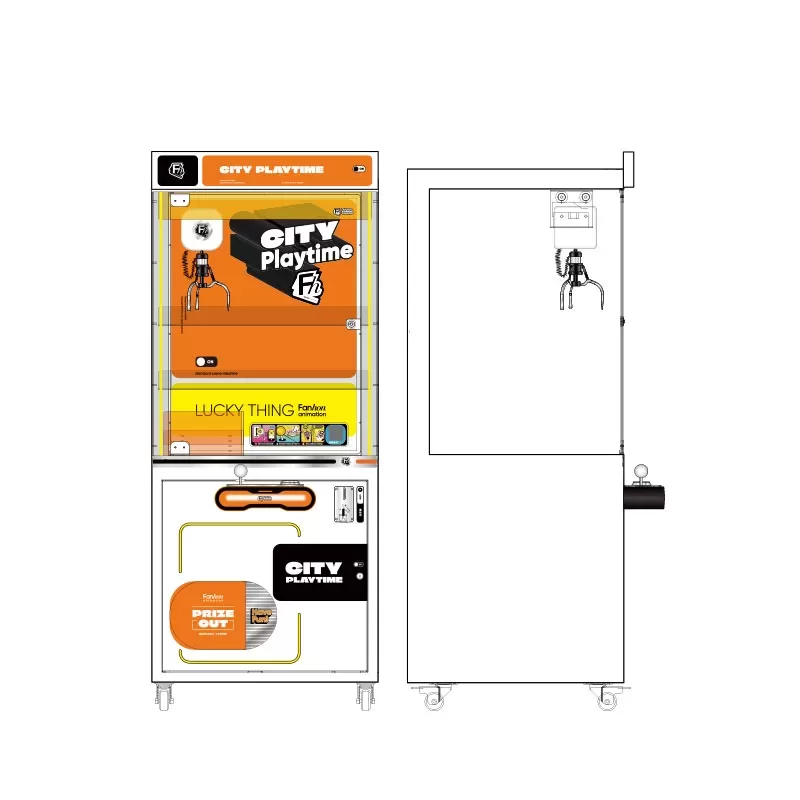
Your logo and visual identity are often the most visible parts of a private label machine.
Potential customization includes:
Logo placement on the cabinet or decorative panels.
Brand colors and graphic themes.
Custom decals and promotional artwork.
Product names or collection names.
Matching visual elements across multiple models.
Prepare high-resolution logo files and brand guidelines before requesting a design mock-up. Confirm the final dimensions, colors, placement, and production method in writing.
For a distributor building a product catalog, consistent branding across different cabinet sizes can make the range easier to recognize. However, the degree of visual consistency will depend on the structure and design limitations of each model.
Cabinet Design and Lighting
Cabinet appearance influences how a machine fits into its venue. A bright, playful design may suit a family entertainment center, while a more restrained design may fit a branded retail environment.
Discuss the following with your manufacturer:
Standard cabinet colors versus special finishes.
Graphic coverage and placement.
Lighting colors and supported effects.
Display and decorative panel options.
Whether the proposed artwork fits the selected cabinet.
Request a digital mock-up before production. If the project involves a large quantity or substantial design changes, ask whether a physical sample or pilot unit is practical.
Gameplay and Prize Configuration
Branding should not be the only consideration. The machine also needs to support your operating model.
Depending on the product, available settings may include claw strength, winning parameters, play duration, prize rules, and modes such as normal play, play-until-win, challenge, or free play.
Confirm the actual features available on the selected model. Do not assume that a setting supported by one machine will also be available on another.
If the machines will operate in multiple markets, establish consistent, documented configurations where appropriate. Also ensure that the gameplay and prize rules comply with the applicable local requirements.
Payment Systems and Language
A private label machine should suit the way customers pay in its target market.
Possible payment configurations may include coins, banknotes, QR-code payments, cards, or cashless systems. Availability depends on the machine, payment hardware, software integration, and local service providers.
Before ordering, specify:
Destination country and currency.
Required payment methods.
Whether a third-party payment terminal is needed.
Preferred interface and instruction language.
Any required local labels or notices.
Confirm the complete configuration and any additional costs in writing. A machine should not be assumed to support a particular payment provider simply because it supports cashless payments in general.
4. How to Choose a Private Label Claw Machine Manufacturer
Your manufacturer will influence the product's appearance, technical configuration, consistency, and ongoing support. Compare suppliers against a written set of requirements rather than choosing based on the lowest initial price alone.
Evaluation factor | What to verify |
|---|---|
Product range | Whether the supplier offers suitable machine sizes and configurations |
Branding capability | Whether it can apply your logo, graphics, colors, and other requested changes |
Technical support | Whether engineers can assess the feasibility of proposed modifications |
Production consistency | Whether specifications can be documented and followed across batches |
Quality inspection | Which functional and cosmetic checks are performed |
Order flexibility | MOQ, mixed-model orders, sample availability, and repeat-order conditions |
Export arrangements | Packaging, shipping documentation, and delivery responsibilities |
After-sales service | Warranty scope, spare parts, troubleshooting, and technical support |
Commercial clarity | Itemized pricing, lead time, payment terms, and exclusions |
IP arrangements | Ownership and permitted use of logos, designs, and project-specific developments |
Questions to Ask Potential Suppliers
Before selecting a manufacturer, ask:
Which existing models are suitable for my private label project?
Which branding options are available for each model?
What is the minimum order quantity for my requested configuration?
Can I combine several models in one order?
Will you provide a design mock-up for approval?
What is included in the quoted price?
How do you maintain consistency between production batches?
What tests will be completed before shipment?
What warranty and technical support are available?
Can we document ownership and permitted use of my brand assets?
Request examples of relevant work where the supplier is authorized to share them. A supplier's general product gallery is useful for understanding its range, but it does not necessarily demonstrate experience with your specific customization requirements.
5. Build a Private Label Product Specification
A written specification helps avoid misunderstandings during design, production, and repeat orders.
Use the following checklist when preparing your inquiry.
Item | Details to confirm |
|---|---|
Machine model | Model name, reference images, dimensions, and configuration |
Quantity | Initial order and expected repeat-order volume |
Branding | Logo files, brand colors, graphics, and placement |
Appearance | Cabinet finish, decorative panels, and lighting |
Gameplay | Supported settings and required modes |
Payment | Country, currency, payment method, and any third-party hardware |
Language | Interface, labels, and instructions |
Prize requirements | Prize type, dimensions, and approximate weight |
Electrical requirements | Destination voltage, plug, and applicable standards |
Compliance | Required certifications, testing, and documents for the target market |
Packaging | Export packaging, accessories, and spare parts |
Acceptance criteria | Cosmetic standards, functional tests, and defect handling |
Commercial terms | Price, MOQ, payment milestones, and lead time |
Intellectual property | Logo usage, design ownership, confidentiality, and exclusivity if agreed |
If you plan to distribute machines to other businesses, consider preparing a standardized specification sheet for each product in your catalog. This makes quotations, product listings, customer support, and repeat purchasing easier to manage.
6. Understand Private Label MOQ and Pricing
There is no single MOQ or price that applies to all private label claw machines. The requirements depend on the base model, type of customization, component sourcing, and production arrangements.
What Affects MOQ?
Standard model with branding: Existing machines with approved logos or decals may have different quantity requirements from new designs.
Special cabinet finishes: Custom materials, colors, or printing processes may affect production conditions.
Technical changes: New components or control-system changes may require additional development and testing.
Payment integration: Specific hardware or third-party systems may affect minimum quantities and setup costs.
Custom language or software: Translation, interface work, and software changes may have separate requirements.
Repeat production: Reusing an approved design may simplify future orders, but MOQ and pricing still need confirmation.
Ask for the MOQ of the complete machine and, where relevant, the MOQ or setup cost of individual customization items.
What Affects the Total Cost?
Cost component | What to ask |
|---|---|
Base machine | What model and standard components are included? |
Branding | Are artwork preparation, printing, and decals included? |
Engineering | Are technical changes charged separately? |
Payment configuration | Are payment hardware and integration included? |
Samples | Is there a sample or prototype charge? |
Quality control | Are special inspections or reports charged separately? |
Packaging | Is export packaging included? |
Shipping | Is freight included, and under which delivery terms? |
Import expenses | Who is responsible for duties, taxes, and customs clearance? |
Spare parts | Are spare parts included or quoted separately? |
For a fair comparison, request quotations based on the same model, quantity, customization scope, destination, and delivery terms. A low machine price may not represent the lowest overall project cost.
7. Create a Repeatable Private Label Production Process
A private label brand needs more than a successful first shipment. Repeat orders should follow documented specifications so that products remain consistent as the business grows.
A practical workflow includes the following steps:
Step 1: Define the market and product range
Identify target customers, intended venues, price positioning, prize types, and the machine models needed.
Step 2: Approve the product specification
Document cabinet appearance, logo files, payment requirements, gameplay settings, and acceptance criteria.
Step 3: Approve artwork and samples
Review the design mock-up and, when appropriate, a physical sample or pilot unit before proceeding with the full order.
Step 4: Inspect production
Verify the agreed branding, machine configuration, functional performance, packaging, and batch quantity.
Step 5: Document the approved version
Retain the final artwork, specification sheet, test requirements, and change history for repeat orders.
Why Repeat-Order Documentation Matters
A logo may change, a payment provider may update its hardware, or a machine model may receive a component revision. Without a documented specification, different production batches may not match your expectations.
For each approved product, maintain a record of:
Final artwork and design version.
Machine model and agreed configuration.
Payment and language specifications.
Inspection and acceptance requirements.
Approved component substitutions, if any.
Spare parts and support arrangements.
Require written approval before material changes are made to the agreed configuration.
8. Protect Your Brand and Design Rights
Private label buyers should clarify intellectual property before sending confidential designs or authorizing production.
Protecting Your Logo and Artwork
Confirm that you have the right to use the logo and artwork you provide. State how the manufacturer may use these files and whether it may display the finished product in marketing materials.
Ownership of Custom Designs
Do not assume that a custom graphic, cabinet design, or software modification automatically belongs exclusively to the buyer. The contract should identify which materials belong to each party and how newly developed work may be used.
Confidentiality and Exclusivity
If your design or commercial plan is sensitive, consider a confidentiality agreement. If you require exclusive production rights for a particular design or market, define the scope, duration, territory, and any exceptions in writing.
Exclusivity is not automatic and may affect pricing, MOQ, and commercial terms.
Brand Protection in the Target Market
Before launching your private label product line, consider registering relevant trademarks and confirming that the proposed product branding does not infringe third-party rights. Legal requirements vary by country, so obtain appropriate advice where necessary.
9. Quality Control, Compliance, and After-Sales Support
A private label machine represents your brand to the end customer. Quality problems can therefore affect both the equipment and your reputation as a distributor or operator.
Suggested Pre-Shipment Checks
Verify cabinet dimensions and exterior appearance.
Check logo placement, colors, and print quality.
Test buttons, joystick, claw movement, and prize release.
Verify the agreed payment configuration.
Confirm gameplay settings and supported modes.
Inspect electrical connections and relevant safety features.
Check that the correct accessories, instructions, and spare parts are included.
Confirm packaging is suitable for the agreed shipping method.
Agree on the inspection method before production. Depending on the order, this may involve testing each machine or applying an agreed sampling procedure.
Verify Compliance for Your Market
Applicable requirements depend on the destination, machine configuration, and intended use. Confirm relevant electrical safety, electromagnetic compatibility, labeling, and other requirements before ordering.
Request documentation for the specific model and configuration. Do not assume that one certificate covers every product in a supplier's catalog or every modified version.
Plan for After-Sales Service
Before placing a bulk order, establish how the supplier will handle technical questions, spare parts, warranty claims, and troubleshooting.
Clarify:
Warranty duration and exclusions.
Which components are covered.
The process for reporting faults.
Required photos, videos, or diagnostic information.
Spare-part availability and ordering procedures.
Remote technical support arrangements.
Responsibility for shipping replacement parts.
Written support terms help you plan service for machines installed at customer sites or across multiple venues.
10. Why Consider Fanhong for Private Label Claw Machines?
Fanhong, operated by Guangzhou Fanhong Animation Technology Co., Ltd., manufactures commercial claw machines and other arcade entertainment equipment in Panyu, Guangzhou, China.
The company supports B2B buyers looking for commercial machines and project-specific customization. Depending on the selected model and confirmed requirements, options may include cabinet colors, logos, decals, lighting, payment configurations, and gameplay settings.
Fanhong can discuss product selection and customization requirements with distributors, arcade operators, family entertainment centers, and other commercial buyers.
For a private label inquiry, prepare the following information:
The machine model or a reference image.
Your estimated order quantity.
Your logo and branding requirements.
Your target country and payment preferences.
Your prize dimensions and operating requirements.
Your target delivery schedule.
This information helps the team assess feasibility and prepare a quotation based on the actual project scope.
Visit the Fanhong factory page or contact the team on WhatsApp at +86 18922467886 to discuss your requirements.
11. Frequently Asked Questions About Private Label Claw Machines
1. What are private label claw machines?
Private label claw machines are machines sold or operated under a buyer's brand. They are often based on an existing machine model with approved branding or configuration changes.
2. Can I put my own logo on a claw machine?
Logo customization may be available depending on the machine model and project requirements. Confirm the artwork format, placement, production method, MOQ, and cost before approving the order.
3. Do private label claw machines require a large MOQ?
Not necessarily, but MOQ varies by model and customization. Standard-model branding may have different requirements from custom cabinets, special components, or software development. Request the MOQ for your specific project.
4. Can I create a completely new claw machine design?
Some manufacturers may support more extensive development, but feasibility depends on engineering capability, budget, production requirements, and order volume. Confirm design ownership, development costs, testing, and lead time before proceeding.
5. What is the difference between private label and OEM claw machines?
Private label describes selling equipment under your own brand. OEM describes manufacturing based on agreed specifications. A private label project may use an OEM arrangement, so confirm the actual service scope with the supplier.
6. Can I customize payment systems and gameplay?
Some models support multiple payment configurations and adjustable gameplay settings. Availability depends on the hardware, software, payment provider, and target market. Confirm the required configuration in writing.
7. How can I protect my private label design?
Use clear written agreements covering logo use, confidential information, design ownership, software changes, and exclusivity where required. Consider trademark protection and legal advice for commercially sensitive projects.
8. How do I ensure consistent quality across repeat orders?
Keep an approved specification sheet, final artwork, configuration records, and inspection criteria for each product. Require written approval for significant changes before production.
9. What information should I provide when requesting a quotation?
Provide the model or reference image, quantity, branding files, desired configuration, destination country, payment requirements, prize specifications, and target delivery date. These details help the manufacturer prepare a more relevant quotation.
Conclusion
Private label claw machines can help distributors, operators, and entertainment brands develop a more recognizable product offering without necessarily creating a machine from scratch.
The most important steps are to select a suitable base model, define the customization scope, document intellectual property and commercial terms, approve the final specifications, and establish clear quality and after-sales procedures.
With a well-defined process and a suitable manufacturing partner, businesses can make private label purchasing more predictable and prepare for consistent future orders.
