


OEM Claw Machine Manufacturer: Customization and Buying Guide
An OEM claw machine manufacturer helps businesses develop claw machines that match their brand identity, product specifications, and operating requirements. Depending on the project, customization may include cabinet colors, logos, graphics, lighting, payment systems, and gameplay settings. Before placing an order, buyers should confirm the available options, production specifications, quality inspection process, intellectual property arrangements, and delivery schedule.
For arcade brands, distributors, family entertainment centers (FECs), and multi-location operators, choosing the right manufacturing partner is an important step toward building a consistent product offering.
1. What Is an OEM Claw Machine Manufacturer?
An OEM claw machine manufacturer produces machines according to a buyer's agreed specifications. Instead of purchasing only standard, ready-to-sell equipment, a business can work with the manufacturer to adapt selected features to its brand and market requirements.
Typical OEM projects may involve:
Applying a company logo to the machine cabinet.
Customizing cabinet colors, decals, and graphic designs.
Selecting suitable lighting effects and display configurations.
Configuring payment methods for the target market.
Adjusting supported gameplay parameters.
Preparing consistent machine specifications for multiple locations.
The available options depend on the machine model, technical requirements, order quantity, and manufacturing arrangements.
OEM vs. ODM: What Is the Difference?
Item | OEM | ODM |
|---|---|---|
Main approach | Production based on agreed buyer specifications | Adaptation or development based on the manufacturer's existing designs and capabilities |
Design input | The buyer may supply artwork, specifications, or design requirements | The buyer selects or develops a product with the manufacturer's design support |
Typical customization | Branding, cabinet appearance, configuration, and approved features | Existing product adaptation or a more extensively developed design |
Best suited for | Businesses with defined product or brand requirements | Buyers who want to build on an existing product concept |
Key consideration | Confirm technical feasibility and specification ownership | Confirm which design elements can be changed and who owns the resulting intellectual property |
In practice, OEM and ODM services can overlap. Ask the manufacturer to describe the actual scope of work instead of relying on the label alone.
2. What Can You Customize on an OEM Claw Machine?
Customization should begin with your business requirements rather than with appearance alone. A machine that looks attractive but does not support your payment system, prize sizes, or operating environment may create unnecessary costs later.
Cabinet Color, Logo, and Graphics
Branding options may include:
Cabinet body color.
Company logo placement.
Custom stickers and printed graphics.
Lighting color and visual theme.
Product name and promotional artwork.
Consistent design elements across a group of machines.
Before production, provide high-resolution artwork and confirm the logo position, dimensions, colors, and print method. Ask for a digital mock-up or another suitable approval reference when the project requires it.
If you plan to order machines for several locations, establish a standard design specification so that later batches can maintain a consistent appearance.
Gameplay and Prize Settings
For a commercial claw machine, gameplay configuration can be as important as exterior design.
Depending on the model, available settings may include:
Claw strength and related operating parameters.
Prize-winning settings.
Play duration and round limits.
Prize rules.
Normal play, play-until-win, challenge, or free-play modes.
Not every machine supports every mode or parameter. Confirm the control system and available settings before ordering, especially if your business model depends on a particular gameplay configuration.
Also confirm that gameplay settings can be adjusted legally and transparently in your operating market. Ask for the relevant technical documentation and test the agreed configuration before accepting the order.
Payment Systems and Language
Payment requirements vary by country, venue, and customer base.
Possible configurations include:
Coin operation.
Banknote acceptance.
QR-code payments.
Card or cashless payment systems.
Supported mobile payment options.
Local-language interfaces, where available.
These options are model- and market-dependent. A machine that accepts coins should not automatically be assumed to support a particular card reader or mobile payment provider.
Before production, provide the destination country, preferred payment methods, currency requirements, and language requirements. Confirm the hardware, software, integration costs, and any third-party service fees in writing.
Machine Size and Prize Compatibility
The cabinet dimensions, internal space, claw mechanism, and prize chute determine what products a machine can handle.
Discuss the following with your manufacturer:
The intended prize dimensions and approximate weight.
Whether prizes are plush toys, boxed products, small gifts, or other merchandise.
The required cabinet size and installation footprint.
The expected prize-loading and replenishment process.
Any clearance requirements for the venue.
If possible, provide representative prize samples or accurate measurements. This helps the manufacturer evaluate compatibility before mass production.
3. How to Choose the Right OEM Claw Machine Manufacturer
A supplier should be evaluated on more than its product photos or initial quotation. Review its engineering capabilities, communication, production process, documentation, and ability to meet your actual specifications.
Evaluation area | What buyers should check |
|---|---|
Manufacturing capability | Whether the supplier can produce the required machine types and configurations |
Customization experience | Examples of comparable branding or technical customization projects |
Engineering support | Ability to review specifications and assess technical feasibility |
Quality control | Inspection stages, functional tests, and acceptance criteria |
Production planning | Estimated lead time, order milestones, and change-control process |
Export experience | Packaging, shipping arrangements, and export documentation |
After-sales support | Warranty terms, spare parts, troubleshooting, and technical assistance |
Commercial transparency | Clear pricing, payment terms, exclusions, and responsibilities |
Questions to Ask Before Ordering
Request clear answers to these questions:
Which machine models support the customization I need?
What is included in the quoted price?
Is there a minimum order quantity for my requested design?
Can I combine different models in one order?
What files, samples, or specifications must I provide?
Will I receive a design mock-up or sample for approval?
How will the manufacturer inspect and test the finished machines?
What are the production lead time and shipping arrangements?
What warranty and technical support are provided?
Who owns the custom artwork, software changes, and other project-specific intellectual property?
A reliable supplier should explain what it can deliver, what requires additional engineering, and what is not supported.
4. Prepare Your OEM Claw Machine Specifications
A written specification reduces misunderstandings between the buyer, designer, engineer, and production team.
Before requesting a quotation, prepare a brief covering these areas:
Specification | Information to provide |
|---|---|
Product model | Preferred model or reference machine |
Order quantity | Number of machines and any planned future batches |
Branding | Logo files, colors, graphics, and placement |
Cabinet design | Required appearance and approved design changes |
Gameplay | Required modes and adjustable parameters |
Payment | Country, currency, and preferred payment method |
Language | Interface and instruction language |
Prizes | Dimensions, approximate weight, and product type |
Electrical requirements | Destination-market voltage, plug, and applicable requirements |
Compliance | Required documents and regulations for the destination market |
Packaging | Individual packaging, shipping method, and delivery destination |
Acceptance | Functional tests, cosmetic standards, and defect criteria |
The more specific the requirements, the easier it is to compare supplier quotations on a like-for-like basis.
If your design is still at the concept stage, provide reference images and describe the intended result. The manufacturer can then clarify which changes are practical for the selected model.
5. OEM Claw Machine Customization and Production Process
A typical OEM project follows a sequence of specification, approval, production, inspection, and delivery.
Step 1: Requirement confirmation
Define the machine model, quantity, branding, gameplay, payment options, destination market, and target delivery date.
Step 2: Design and specification approval
Review artwork, colors, logo placement, technical requirements, and any additional development work. Approve the agreed version before production.
Step 3: Manufacturing and assembly
The factory carries out the agreed fabrication, surface finishing, component installation, assembly, and configuration.
Step 4: Inspection and functional testing
Check the cabinet appearance, controls, claw movement, prize handling, payment configuration, and other agreed acceptance criteria.
Step 5: Packaging and shipment
Confirm final quantities, packaging, shipping documents, delivery terms, and installation or setup instructions before dispatch.
Why Sample or Design Approval Matters
A design image is not the same as an approved production specification. Confirm the final appearance and technical requirements in writing.
For large orders or extensive customization, ask whether a physical sample or pilot unit is practical. A sample may add cost and time, but it can help identify issues before the full batch is produced.
If a physical sample is not practical, establish a clear approval process using drawings, photographs, videos, and written specifications.
6. OEM Claw Machine Cost: What Affects the Price?
The cost of an OEM claw machine depends on the base model, customization scope, order quantity, payment configuration, and delivery requirements.
Cost factor | Potential price impact |
|---|---|
Base machine model | Cabinet size, components, display configuration, and construction |
Custom artwork | Design preparation, printing, decals, and special finishes |
Engineering changes | Structural changes, control-system adjustments, or new features |
Payment system | Additional hardware, software integration, and provider-related costs |
Language customization | Interface translation and implementation, if supported |
Order quantity | Production setup, purchasing, and batch economics |
Inspection and packaging | Special acceptance procedures or export packaging |
Logistics | Freight, insurance, customs duties, taxes, and destination delivery |
When comparing quotes, distinguish between the machine price and the total landed cost.
The total project budget may include equipment, customization, spare parts, freight, import duties, taxes, installation, and ongoing operating expenses. Not every supplier includes these items in its initial quotation.
Ask for a written breakdown of included and excluded costs. This makes it easier to compare proposals accurately and avoid unexpected expenses.
7. MOQ and Lead Time for OEM Orders
Minimum order quantity (MOQ) and production lead time depend on the machine model and requested changes.
Some standard-model branding changes may be possible in small quantities, while extensive design development, special components, or custom software may require different order conditions.
Before placing an order, confirm:
MOQ for the selected machine and each customization.
Whether different models can be combined in one shipment or order.
Whether sample orders are available.
The expected production schedule after specifications and payment are confirmed.
How design changes after approval affect price and delivery.
Whether replacement parts or repeat orders can follow the same specifications.
For planning purposes, Fanhong's typical production lead time for confirmed orders is approximately 25–30 days after payment, subject to the model, order quantity, customization requirements, and current production schedule. Buyers should confirm the actual timeline for each project.
Do not base a venue opening date solely on the production estimate. Allow additional time for shipping, customs clearance, local delivery, installation, and testing.
8. Protect Your Brand and Intellectual Property
Brand owners should address intellectual property before sharing detailed design files or approving production.
Consider the following safeguards:
Logo and artwork: Confirm who owns the supplied artwork and how the manufacturer may use it.
Confidential designs: Use an appropriate confidentiality agreement when sensitive drawings or business information are shared.
Custom components: Identify any newly developed parts and agree on ownership and permitted use.
Software changes: Specify ownership, access, licensing, and restrictions for project-specific software or gameplay modifications.
Production authorization: Define whether the supplier may manufacture the same custom design for other customers.
Brand use: Clarify whether the manufacturer may display your logo or project photos in marketing materials.
Written records: Keep approved drawings, specifications, change requests, and acceptance records.
Do not assume that paying for customization automatically transfers every design or software right to the buyer. Ownership and exclusivity should be agreed in writing and reviewed under the relevant laws.
For trademarks, patented designs, or commercially sensitive technology, seek appropriate legal advice before sharing or commercializing the project.
9. Quality Control and Compliance for Export Markets
An OEM project should include an agreed inspection plan. Inspection requirements should be specific enough that both parties understand what constitutes an acceptable machine.
Recommended Inspection Points
Cabinet dimensions and external appearance.
Logo placement, print quality, and color consistency.
Door, lock, and access-panel operation.
Control buttons, joystick, and display functions.
Claw movement and prize-release operation.
Payment-system operation using the agreed configuration.
Electrical components and wiring.
Gameplay settings and other customized functions.
Packaging condition and the inclusion of agreed accessories.
For multi-unit orders, decide whether inspections will cover every machine or a defined sample of the batch. Record any defects and agree on the process for correction before shipment.
Check Destination-Market Requirements
Electrical safety, electromagnetic compatibility, labeling, and other regulatory requirements vary by destination and product configuration. Buyers should identify applicable requirements before ordering and confirm which documents are available for the specific model.
Do not assume that a certificate issued for one machine automatically covers every model or customized version. Verify the document holder, model scope, applicable standards, and validity where relevant.
10. Why Work with Fanhong for OEM Claw Machines?
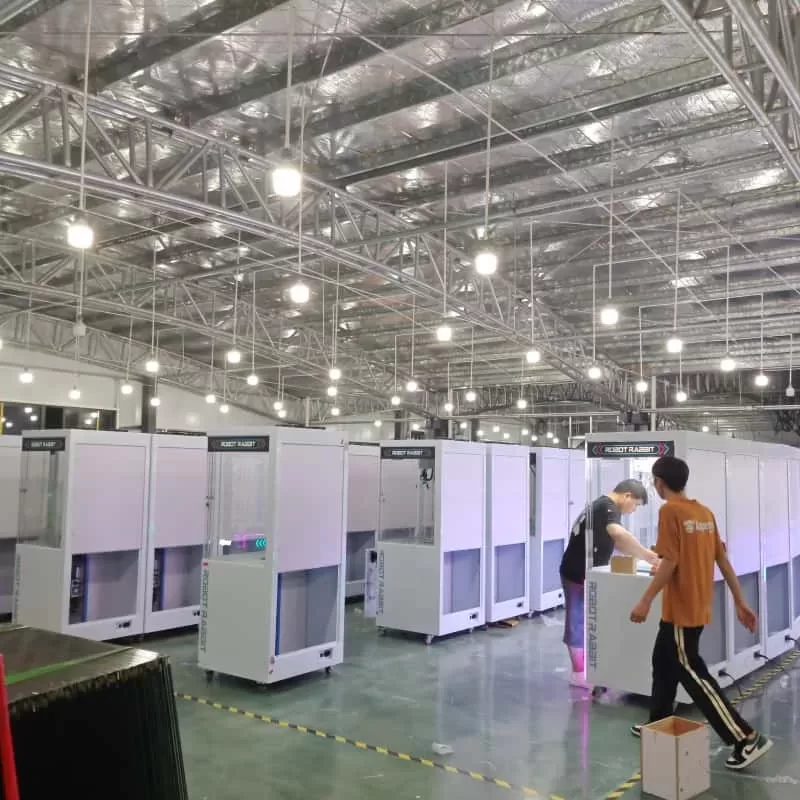
Fanhong, operated by Guangzhou Fanhong Animation Technology Co., Ltd., manufactures commercial claw machines and other arcade entertainment equipment in Panyu, Guangzhou, China.
The company works with overseas buyers on equipment selection and project-specific customization. Depending on the selected model and confirmed requirements, customization may include cabinet appearance, logos, decals, lighting, payment configuration, and gameplay settings.
For B2B buyers, the project discussion can cover:
Machine selection for arcades, FECs, malls, cinemas, and other entertainment venues.
OEM and ODM requirements for brands and distributors.
Product configuration and customization feasibility.
Production planning, functional testing, and export packaging.
Technical support and after-sales arrangements.
Fanhong's stated production lead time for confirmed orders is typically 25–30 days after payment, subject to project details and production scheduling. Warranty coverage and technical support should be confirmed in the quotation and applicable warranty terms.
To discuss your project, visit the Fanhong factory website or contact the team through WhatsApp at +86 18922467886.
11. OEM Claw Machine Manufacturer: Frequently Asked Questions
1. What does an OEM claw machine manufacturer do?
An OEM claw machine manufacturer produces machines according to agreed buyer specifications. Depending on its capabilities, it may support branding, cabinet appearance, payment configuration, gameplay settings, and other approved modifications.
2. What is the difference between OEM and ODM claw machines?
OEM generally focuses on manufacturing according to buyer specifications, while ODM generally involves adapting or developing a product using the manufacturer's design capabilities. The exact service scope varies by supplier, so confirm it before ordering.
3. Can I order OEM claw machines with my own logo?
Logo customization may be available for selected models. Confirm the logo placement, artwork format, printing method, MOQ, and any associated charges with the manufacturer before production.
4. Can I customize the gameplay of a claw machine?
Some models support adjustments to claw strength, winning settings, play duration, prize rules, and game modes. The available settings vary by model and control system and should be confirmed before purchase.
5. What is the MOQ for OEM claw machines?
There is no universal MOQ for every OEM project. Standard-model branding, custom cabinets, new components, and software development can have different quantity requirements. Ask for the MOQ for each part of your requested customization.
6. How long does OEM claw machine production take?
Production time depends on the model, order quantity, customization, and approval process. Fanhong's typical production estimate for confirmed orders is approximately 25–30 days after payment, but the actual schedule should be confirmed for each project.
7. Can I use my own design for a custom claw machine?
You can submit your design concept, logo, or artwork for feasibility review. The manufacturer should confirm what can be implemented and whether additional engineering, tooling, or software work is required. Ownership and permitted use of the design should be documented.
8. How can I check the quality of an OEM claw machine before shipment?
Agree on inspection criteria before production. Request relevant photos, videos, test records, or a sample inspection, and clarify how defects will be corrected. For large orders, agree on whether each machine or a representative sample will be inspected.
9. What should I include in an OEM claw machine inquiry?
Provide your target quantity, preferred model or reference image, branding requirements, destination country, payment preferences, prize dimensions, electrical requirements, and target delivery date. These details help the manufacturer assess feasibility and prepare a more accurate quotation.
Conclusion
Choosing an OEM claw machine manufacturer involves more than finding a factory that can add a logo. Buyers should assess customization capability, production controls, payment compatibility, intellectual property arrangements, inspection standards, and delivery planning.
A clear specification and documented approval process help reduce misunderstandings, protect brand consistency, and make repeat orders easier to manage. Start with your target market and operating requirements, then confirm the exact machine configuration and commercial terms with the manufacturer.
